2-Day Rwenzori Trek to Lake Mahoma | The Ultimate Guide
The 2-day Rwenzori trek to Lake Mahoma is a moderately challenging, non-summit trekking loop covering approximately 22 km. It starts at Nyakalengija (1,650 m) and climbs to a maximum elevation of 2,988 m. The trek takes hikers through dense montane and bamboo forests, offering great wildlife viewing and crater lake views.
Take a two-day trip into the heart of Africa’s Rwenzori Mountains National Park to reach a mountain lake that is both beautiful and surprisingly undiscovered. At an elevation of 2,988 meters, the volcanic crater lake known as Lake Mahoma is surrounded by moss-draped Afro-montane forest. This area is home to unique species that are not found anywhere else on Earth, and the mountain’s comparatively low annual visitor count ensures a tranquil atmosphere. The most comprehensive short-night hiking experience offered by the Rwenzori is the 2-Day Rwenzori Trek to Lake Mahoma via the Mahoma Loop Trail.
Those interested in seeing the beautiful, unspoiled “Mountains of the Moon” in Uganda can do so on a two-day walk to Lake Mahoma in the Rwenzori Mountains. Experience the exhilaration of trekking with our knowledgeable Rwenzori guides for two days through dense montane forest, bamboo groves, and misty ridges.
The Mahoma Loop is a secluded path through thick woodland that this Rwenzori walk follows. It leads to the 52 alpine lakes of the Rwenzori range, the largest and deepest of which is Lake Mahoma. Along the way, you may see rare Rwenzori birds, black and white colobus monkeys, three-horned chameleons, and stunning views of tree-covered valleys.
If you want to explore the most beautiful mountain range in Uganda without having to climb any of the highest peaks, this 2-day Rwenzori walk is a great option. Short safaris or weekend getaways are the perfect fit.
Among the most popular pathways in Rwenzori Mountains National Park are the Rwenzori Central Circuit, Kilembe Trail, and Bukurungu Trail. They are attractive to any hiker who sets out on the Stanley Ascent. Those interested in nature treks and birdwatching expeditions love the Mahoma Trail and the Kazingo Trail, two small routes in the Mountains of the Moon.
Why the 2-Day Rwenzori Trek to Lake Mahoma?
You could say that Lake Mahoma is one of the best-kept secrets in all of Africa. It is encircled by pristine Afro-montane forest that has remained mostly unchanged since the arrival of the first European explorers in the late nineteenth century, having been formed in a volcanic crater at an elevation of 2,988 meters in the center of the Rwenzori range. Before the afternoon fog descends and shrinks the world to ten meters in all directions, the lake is dark and completely quiet in the mornings, reflecting the moss-covered trees that fall right to its borders. This two-day route provides the most accessible and comprehensive introduction to the Rwenzori for hikers looking for a true first experience with the mountain.
The 2-day Rwenzori trek to Lake Mahoma stands out from other short East African treks due to its combination of true altitude, outstanding biodiversity, and almost total lack of tourists. As you make your way around this UNESCO World Heritage Site, keep in mind that it gets far less tourists than other mountains on the continent that are similar. Serious birdwatchers go from all over the globe to walk the Mahoma Loop Trail, where you will share the forest with a diverse array of animals, including black-and-white colobus monkeys, three-horned chameleons, Rwenzori turacos, and an avifauna that is both abundant and endemic. Because it is structured as a circle, the two days go through various landscapes in both directions, providing a more comprehensive look at the mountain’s forest zones than would be possible with an out-and-back.
The main attraction is camping overnight near Lake Mahoma. The tent is just meters away from the edge of the crater, and one of the best parts of trekking in the Rwenzori is waking up in the morning to see the lake entirely reflective in the light before sunrise. While you sleep at the lake, you can explore the crater rim, see the sun go down over the mountain, and hear the tree hyraxes call in the dark, see condensation fall from the canopy, and feel completely alone from the world below. This hike is a perfect jumping off point for individuals who are interested in continuing their exploration of the range on the 7-day Margherita Peak Climb or the 3-day Mahoma Loop Hike.
Out of all the overnight treks in the Rwenzori range, this one is the easiest for beginners. The entire ascent takes place over the course of two days, and the highest point is 2,988 meters, which is low enough that most hikers won’t be worried about becoming sick from the high altitude. The two-day Lake Mahoma trek is an excellent way to get a feel for the mountain and prepare for a longer Rwenzori excursion. This identical progression is covered in our beginners’ guide to climbing the Rwenzori.
A Detailed 2-Day Rwenzori Trek to Lake Mahoma Itinerary
Day 1: Nyakalengija to Lake Mahoma Camp | 1,650 m to 2,988 m | ~11 km | 5 to 7 hours
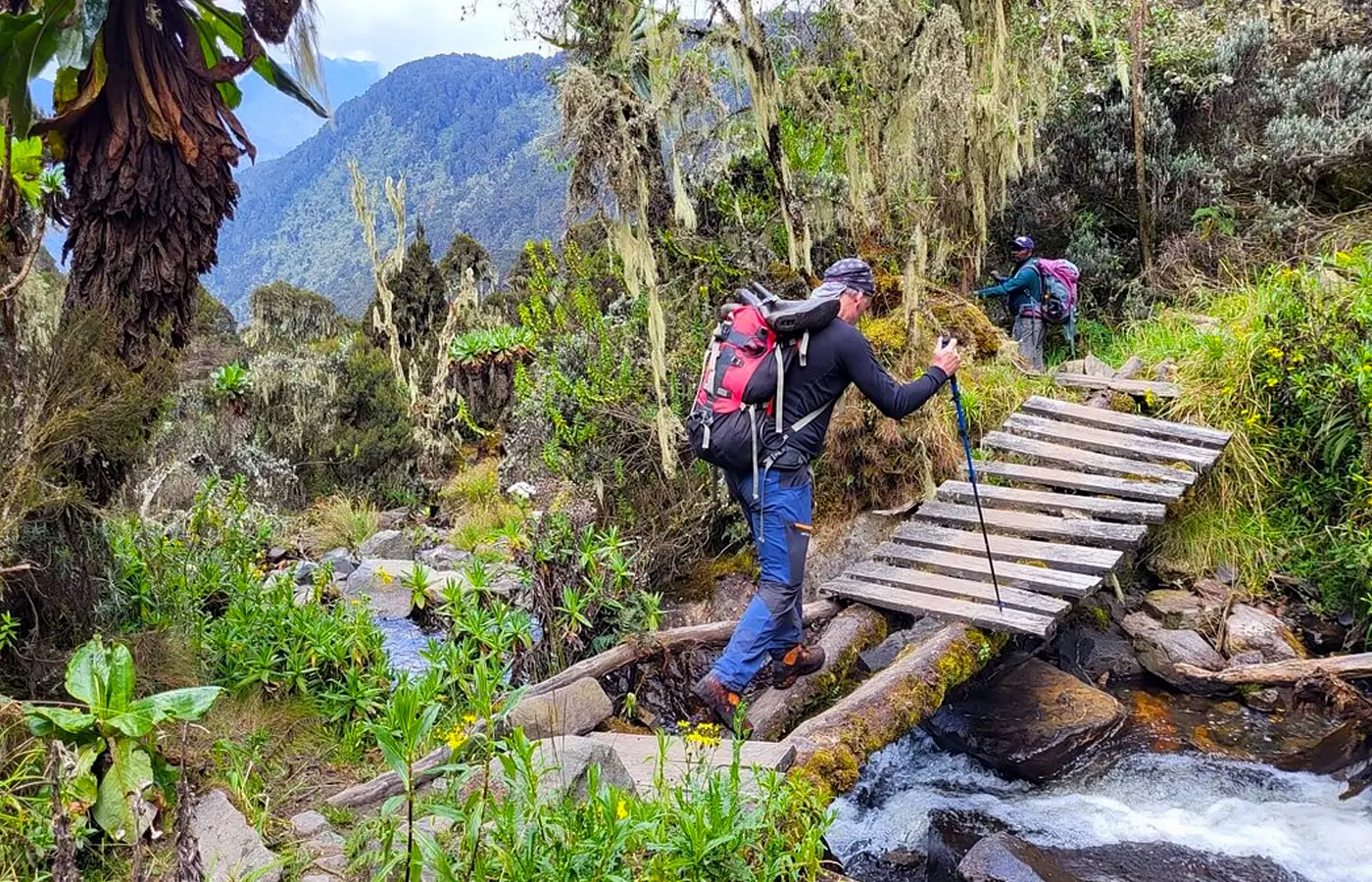
Starting before dawn in Kasese, you will spend two days hiking the Mahoma Loop Trail. You can reach the settlement of Nyakalengija and the Mihunga Park Gate, the primary entrance point to Rwenzori Mountains National Park, by a 20-minute drive. Make sure to be at the registration desk, meet your professional ranger guide from the Uganda Wildlife Authority, and check your equipment one last time by 7:00 AM.
The trail begins at 1,650 meters at Mihunga Gate and continues north through the buffer zone of farmland that separates the protected forest boundary from the cultivated slopes of Kasese. For the initial forty minutes, you will meander through the shadowed fields of bananas, beans and maize owned by the smallholder Bakonzo family. Upon entering the park, there is an abrupt and noticeable change: the trail dives into a thick montane forest, the temperature drops, and the path becomes narrower, rooted, wet, and much more difficult.
Podocarpus trees covered in moss, enormous tree ferns creating an ancient understory, and an overabundance of epiphytes and orchids cover every surface in the lower montane forest zone, which extends from 1,650 to 2,200 meters. The ground level is a good place to spot three-horned chameleons. One of the most picturesque parts of the Mahoma Loop Trail, the mountain bamboo forest, is accessible within two or three hours of setting out. Towering ten to fifteen meters above the trail, stands of enormous bamboo (Arundinaria alpina) form a verdant tunnel reminiscent of a cathedral. The Rwenzori sunbird and the African emerald cuckoo both consider this to be their ideal habitat. Species distribution in the Rwenzori is broken down by altitude zone in our comprehensive wildlife guide.
Ascending sharply from the bamboo, the path winds its way through high Afro-montane forest, where the temperature drops and the moss grows thicker. The forest scenery more than makes up for the hard climb. The high canopy is a common habitat for black-and-white colobus monkeys. At about 2,988 meters, you will reach the rim of the crater, after a total climb of about 1,338 meters. The crater plunges precipitously to the perfectly round dark lake below, surrounded by vegetation on all sides; this view ranks among the most dramatic moments of the entire Rwenzori short trekking. Located on the rim above the northern shore is Lake Mahoma Camp.
Upon arrival at camp, lunch is served. You can spend the afternoon relaxing on the rim of the crater or taking a leisurely stroll down to the edge of the lake. Temperatures decrease to 8 to 12 degrees Celsius in the evening at an altitude of 2,988 meters. Your camp cook will be in charge of making dinner. Assuming weather permits, the sunset over the valley and crater is breathtaking.
Day 2: Lake Mahoma Camp to Nyakalengija | 2,988 m to 1,650 m | ~11 km | 4 to 5 hours
Most hikers take thirty to forty-five minutes after breakfast to retrace their steps around the lakeshore and crater rim in the early light before setting off on their descent. The second day of the 2-Day Rwenzori hike to Lake Mahoma follows the return circle of the Mahoma circle Trail. This trail takes you through a different valley on the way back to Nyakalengija, offering a whole new set of landscapes and viewpoints.
On clear mornings, the descent takes you via a series of ridge portions at an elevation of 2,400 to 2,600 meters, where you can see across forested valleys to Lake George and the base of the Rift Valley. On the way back, you’ll pass through the bamboo forest and lower montane zone again, which offers a new vantage point for wildlife viewing and birdwatching. Because the trail surfaces are wet and rooted, trekking poles are just as necessary for the descent as they are for the ascent. Between the hours of 12:00 and 14:00, you usually make your way back to Mihunga Gate.
At this point, you’ll need to make a decision. If you’re feeling adventurous and want to see more of the mountain, our guides are happy to talk about the 2-Day Rwenzori Trek to Lake Mahoma or organise a full expedition to Margherita Peak along the Central Circuit Trail. Upon returning to Kasese, you will be transferred to your accommodation.
End of the 2-Day Rwenzori Trek to Lake Mahoma (Mahoma Loop Trail Guide)