3-Day Rwenzori Trek to Sine & Samalira Guide | Kilembe Trail
The 3-day Rwenzori hike to Sine & Samalira (via the Kilembe Trail) is a condensed, non-technical trek. It ascends from the Afro-montane forest to the giant heather zone. Covering roughly 20 km, this adventure features river crossings, the 200 m Enock’s Falls, and panoramic views of Queen Elizabeth National Park.
Trek with a guide across the Rwenzori Mountains for three days, stopping at Sine Camp and Samalira Camp along the way. Alpine zones, waterfalls, afro-montane forests, and avian life.
This three-day Rwenzori Trek, which follows the picturesque Kilembe Trail, provides a streamlined yet comprehensive exploration of the mountain’s most varied ecosystems. If you’re looking for a genuine Rwenzori experience without committing to a long, demanding summit trip, this route is for you. It passes through lush forests, stunning waterfalls, bamboo jungles, high-altitude heather vistas, endangered birds, and more.
Among the numerous mysteries concealed by Africa’s Mountains of the Moon, the three-day trek down the Kilembe Trail to Sine Camp and Samalira Camp is one of the most approachable and life-altering. A haunting heather zone at 3,170 m, one of the most unusual high-altitude landscapes on the African continent, will greet you as you ascend from the verdant tropical floor of the Nyamwamba Valley in under 72 hours. You will push through bamboo tunnels that feel like another world.
This is far from a picnic. Mud, constant rain, and mentally and physically taxing terrain are the Rwenzori Mountains’ most infamous features. But that is the same thing that makes the little walk worthwhile. With each strenuous step, you’ll reach a once-in-a-lifetime landscape: old moss-draped forests, roaring waterfalls at Enock Falls, ridge-top camping in Queen Elizabeth National Park with vistas stretching toward Lake George, and the haunting quiet of the heather zone at dawn.
Ascending steadily through the Nyamwamba Valley, the trail eventually returns to its starting point, which is near Kyanjuki hamlet, 12 km from Kasese town, via the old Kilembe Copper Mines.
As it winds its way through a variety of ecosystems, from tropical rainforest to alpine, the Kilembe Trail passes through breathtaking valleys adorned with waterfalls and unique flora. This amazing journey often takes between seven and ten days to complete. This route is ideal for fit beginners with all the necessary gear because it includes camps like Sine, Kalalama, and Mutinda and has a gentler climb and rapid descent compared to other routes.
What Makes the 3-Day Rwenzori Trek to Sine & Samalira Unique
This 3-Day Rwenzori Trek to Sine & Samalira provides the most comprehensive ecological cross-section for the time invested out of all the short treks accessible in Rwenzori Mountains National Park. Over the course of three days, you’ll see a wide variety of flora, fauna, and microclimates as you make your way through the Afro-montane forest, bamboo zone, and lower heather zone. In contrast, shorter hikes to Sine Camp that only take a day or two will only take you as far as the forest’s upper edge. On this journey, you will go far beyond.
Two primary pathways lead into the heart of the Rwenzori Mountains, and the Kilembe Trail is one of them. Starting near the old Kilembe Copper Mines south of Kasese, the Kilembe Trail adds an extra layer of industrial and cultural history to the walk, in contrast to the Central Circuit Trail, which starts at the northern Nyakalengija gate. The Nyamwamba Valley, a section of equatorial Africa that the path traverses, is among the most spectacularly shaped glacial valleys in the continent. Melting ice sheets formed the valley over thousands of years, but global warming has caused them to retreat considerably. It is as if you are strolling through a geological time capsule.
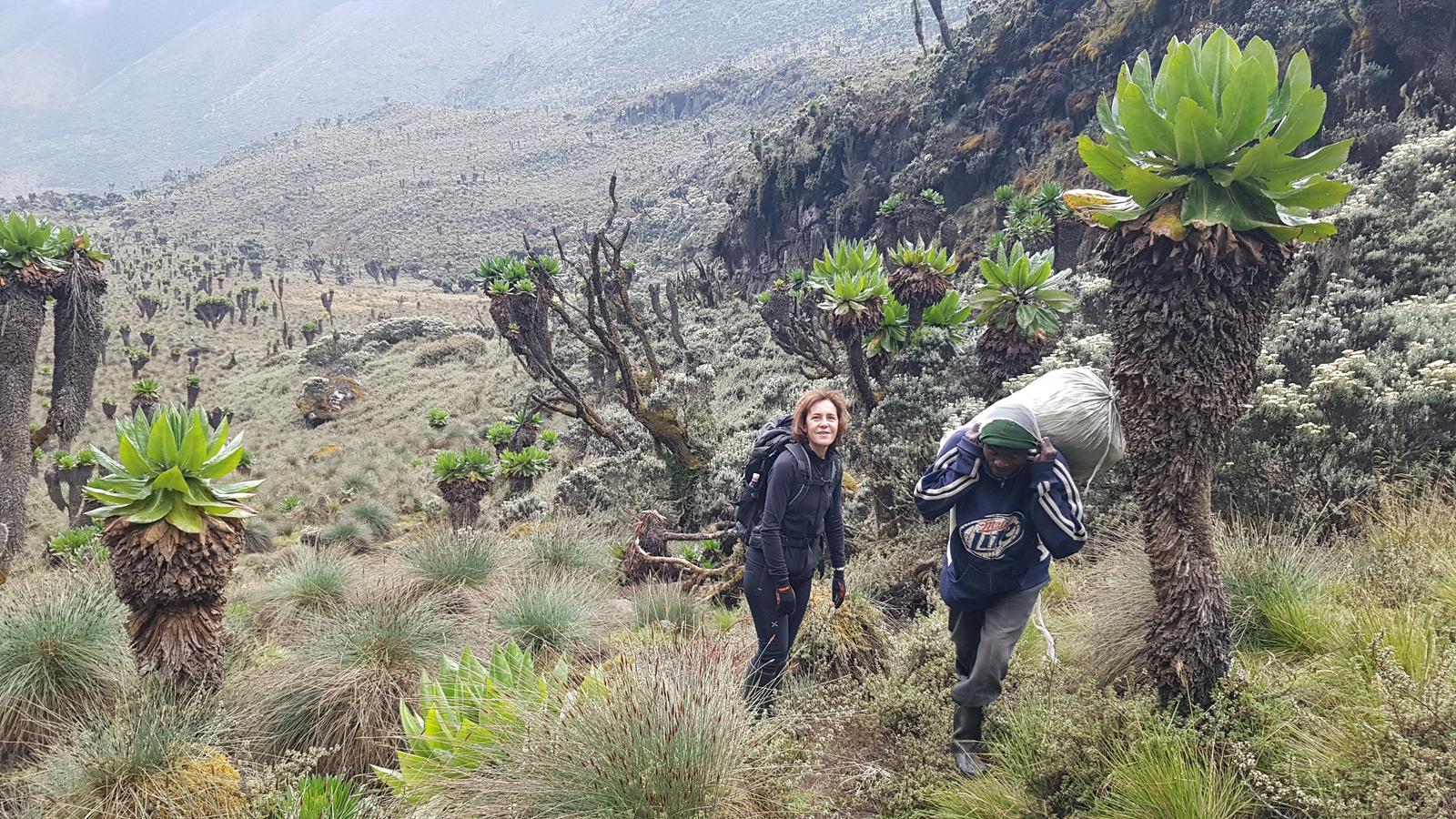
On Day 2, the dense lower woodland gives way to the bamboo zone, setting this journey apart for wildlife fans. One of the most evocative parts of the Kilembe Trail is the bamboo portion. The trees are tall and verdant, and you can hear the rustle of blue monkeys and the cries of Rwenzori turacos as you walk through them. Among the most photographed subjects in the Rwenzori are the gigantic lobelias, which are unique to the high-altitude zones of Africa and become visible as you near Kalalama and Samalira Camps.
If you are short on time in Uganda but still want to see the Rwenzori Mountains, this journey is a great alternative to the full summit adventure, which takes 7–10 days. If you’re interested in returning for the 7-day climb of Margherita Peak via the Central Circuit or the 8-day Kilembe Trail expedition to Margherita Peak, this trek is a great way to get a feel for the mountains, acclimatise to the altitude, and test your fitness levels in these unique circumstances.
A Detailed 3-Day Rwenzori Trek to Sine & Samalira Itinerary
Day 1: Kyanjuki Trailhead to Sine Camp
Elevation: 1,450 m → 2,596 m | Distance: 9.5 km | Hiking Time: 7–8 hours | Terrain: Forest trail, steep ascent
The Rwenzori journey starts at the Trekkers Hostel in Kyanjuki hamlet, some 12 km from Kasese town, on the road that goes past the Kilembe Copper Mines. The day begins with a comprehensive gear check, an introduction to your porter team, a pre-trek briefing by your lead guide, and a review of the day’s itinerary. Our usual departure time is 8:30 AM; To make sure you get to Sine Camp before it becomes dark, the latest start time is 10:00 AM.
At an elevation of 1,727 meters, you’ll reach the Uganda Wildlife Authority (UWA) ranger post after a 2.2-kilometer easy warm-up walk on a mostly level terrain. Bring your passport and confirmation of reservation to finish the park entrance procedures. After a short ascent from the ranger station, the trail enters the Afro-Montane Forest Zone.
Ascending steadily and manageably over the first six kilometres within the park, you’ll pass through one of the most pristine montane forests in Uganda. Underneath the dense canopy of towering Podocarpus and Symphonia trees lies a thick understory of gigantic ferns, orchids, and flowering shrubs. A thick covering of moss and decaying leaf litter covers the forest floor; the aroma is rich, moist, and quite tropical. There is always the sound of birdsong; your guide will be sure to point out the calls of several species, including the beautiful francolin, the African wood owl, and the African green broadbill.
The last two or three kilometres leading up to Sine Camp are extremely steep when you pass a river bridge. The most difficult part of the day is ahead of you: a long ascent through a mossy forest, with roots from trees crunching underfoot and a precipitous valley dropping off to your left. It is not uncommon to see blue monkeys gliding among the trees up here. Do not rush; instead, breathe deeply and steadily as you follow your instructions.
Before you even see the cabins, the sound of waterfalls heralds Sine Camp (2,596 m). Above the breathtaking Nyamwamba Valley’s rapids and cascades, the camp is situated on a narrow forested hill. A 200-meter detour from camp brings you to Enock Falls, a picturesque cascade surrounded by drooping vines and verdant lichen that has become one of the Kilembe Trail’s most popular photo ops. Go ahead and do it.
Your guiding group will cook a hearty dinner for you to enjoy at camp. Nights at Sine Camp are chilly and evocative, with temperatures dropping to 8 to 12 degrees Celsius; a bonfire or the wooden hut’s warmth is a welcome source of solace. Take it easy tonight. Day 2 is less in length, but it goes up into very mountainous country.
Day 2: Sine Camp to Samalira Camp (via Kalalama Camp)
Elevation: 2,596 m → 3,170 m | Distance: 4.1 km | Hiking Time: 3–4 hours | Terrain: Bamboo zone, heather zone, ridge walking
The second day covers less ground, but there is a significant increase in elevation and a dramatic change in landscape. Among the most spectacular changes in every Rwenzori hike is after breakfast at Sine Camp, when the path suddenly ascends from the wooded ridge into the bamboo zone.
The bamboo zone, characterised by the dense, cathedral-like passageways formed by huge mountain bamboo (Arundinaria alpina), starts nearly immediately above Sine Camp. A pale green haze is created as the stalks reach 8-12 meters above the trail. Trekking poles are a must-have due to the sometimes muddy terrain and limited trail. The dense bamboo obscures outside sounds, evoking a creepy acoustic intimacy, while the air brings forth the creak of bamboo stalks brushing against one another.
The more elevation you gain, the more you’ll see pockets of mixed transitional forest, which are home to a wide variety of bird species because to the abundance of fruiting trees. When startled from its perch, a Rwenzori turaco will make its distinctive call, and its bright red flight feathers will shine between the gaps in the canopy. In the dry months, malachite sunbirds fly down from the heather zone into the bamboo-forest ecotone, where they hover near lobelias that are in bloom.
The bamboo rapidly gives way to the heather zone at around 3,000 m, which is one of the most distinctive ecological zones in the Rwenzori and is unique to this latitude on Earth. In this area, the enormous tree heathers (Erica arborea and Erica trimera) can reach heights of up to fifteen meters, with sphagnum moss and lichen covering their thick trunks and branches. The effect is otherworldly, like seeing a forest unfold in slow motion while massive grey-green trees seemingly grow out of thin air.
On most days, you can reach Kalalama Camp (3,147 m) within 2.5-3 hours of departing Sine Camp. On this three-day hike, you will pass through this area, but you will not spend the night here unless absolutely necessary, as it is an alternate overnight stop on longer itineraries. Starting at Kalalama, the trail winds over a grassy, open ridge that, on clear days, offers breathtaking views westward across the foothills to Lake George in Queen Elizabeth National Park—an incredible vista that flows seamlessly from one park to another.
Towering spike-like inflorescences reaching 2-3 meters from a rosette of grey-green leaves are the first big lobelias to develop near Kalalama, Lobelia wollastonii. Photographers love the Rwenzori Mountains for their stunning unique Afro-alpine flora, which are among the park’s most recognisable features. Set in a wide shallow basin at an elevation of 3,170 meters, Samalira Camp is reached after a brief last ascent from Kalalama.
Calm, spectacular, and high in the mountains lies Samalira Camp. At this level, the air is much thinner, and temperatures drop dramatically after dark, expecting 4-8°C at night. The views across the surrounding peaks and valleys are wide. Your guiding group will be prepared with hot beverages, soup, and a hearty meal. Take a seat outdoors before heading back to your hut; when clouds let it, the night sky at 3,170 meters on the Rwenzori is really breathtaking.
Day 3: Samalira Camp to Kyanjuki (Descent)
Elevation: 3,170 m → 1,450 m | Distance: 10 km | Hiking Time: 5–7 hours | Terrain: Heather zone, bamboo, forest, river sections
The last day involves a full circle of the previous route, beginning at Samalira Camp and ending at Kyanjuki base camp, a total of 10 kilometres of descent and 1,720 meters of height loss. The optimal time to leave camp after an early breakfast is between seven and eight in the morning, before the clouds roll in and make it hard to see anything from the heather zone.
The visual experience changes when you descend through the heather zone in the morning light, compared to when you ascend. A foggy, otherworldly ambiance is created by the moss-draped heather trees catching the early light and by the frequent veils of mist that cover the valley below. This is what gives the Rwenzori their old name, “Mountains of the Moon.” Though you might have rushed past giant lobelias on your way up, you should take your time admiring them as you descend.
While the third day’s descent through the bamboo zone is much easier than the climb, you’ll still need to be careful on the muddy, root-infested parts of the track. This is the kind of place where trekking poles and a leisurely pace really shine. The transitional zone is where the morning feeding activity peaks, so the bamboo corridor on the way down is usually busier with birds than it is on the way up.
When you step back into the Afro-Montane forest that lies beneath the bamboo zone, you’ll feel the warmth and hear the birdsong that was missing before. Two possible paths may be presented by your guide near the Omusita Rest Area: one descends directly to the ranger post, while the other takes a picturesque diversion along the Nyamwamba River, passing through an especially evocative stretch of old-growth forest that seems ancient, thick, and primordial. If you have the time and the weather permits, you should definitely follow the river route; it is among the most picturesque parts of the lower Kilembe Trail.
At the end of the day, the hike usually reaches the Kyanjuki base camp after passing the UWA ranger station. At the trailhead, we say goodbye to our guides, swap completion certificates, and divide up any tips. It is possible to organise transportation from Kyanjuki to either Kasese or Fort Portal. Before continuing on their journey, many hikers opt to spend the night in Kasese.
End of the 3-Day Rwenzori Trek to Sine & Samalira | Kilembe Trail Route