
4-Peaks Rwenzori Trek (Margherita, Speke, Weismann & Baker)
The 4-Peaks Rwenzori Trek is a demanding 10-day high-altitude expedition that challenges climbers to summit four distinct peaks: Margherita Peak (5,109m), Mount Speke (4,890m), Mount Baker (4,842m), and Weismann’s Peak (4,620m). Typically starting via the Kilembe Trail in western Uganda, this expedition requires proper acclimatization and technical gear.
On the most daring multi-peak excursion accessible via the Kilembe Trail, summit four of the Rwenzori’s highest peaks: Margherita (5,109m), Vittorio Emanuele (4,890m) atop Mount Speke, Weismann (4,627m) atop Mount Luigi di Savoia, and Edward (4,843m) atop Mount Baker. This is more than just a walk to the summit of the third-highest peak in Africa. Immerse yourself in the alpine for ten days as you traverse four separate massifs, passing through some of the most breathtaking mountain landscapes on the planet, including equatorial glaciers, enormous lobelias, Afro-alpine swamp, and ancient, mist-covered rock faces. What follows next after considering the 7-Day Margherita Peak Climb or the 8-Day Kilembe Trail trek? This is the solution.
Including Weismann’s Peak, Vittoria Emanuele, Margherita Peak, and Edward Peak, the Rwenzori Four Peaks Trek takes ten days. Set out on a ten-day Rwenzori Four Peaks journey along the Kilembe Trail to conquer the fabled Mountains of the Moon in Africa: Margherita, Speke, Weismann, and Baker.
One of the most challenging and rewarding high-altitude hiking and climbing excursions in Africa is this 10-day Rwenzori Four Peaks expedition. You may experience every ecosystem that the Rwenzoris have to offer along the Kilembe Trail. From dense rainforests and bamboo jungles to expansive heather forests, alpine marshes, glaciers, and rocky slopes, you’ll see it all.
8-Day 4-Peaks Rwenzori Trek Highlights
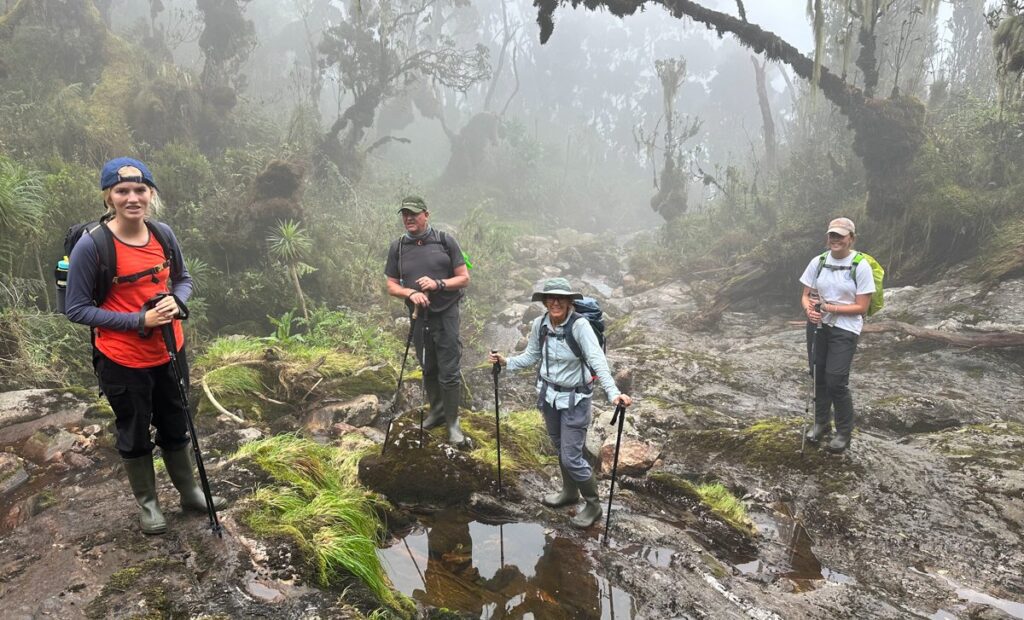
There are more than 50,000 people who try to climb Kilimanjaro every year, but less than 1,500 make the journey to the Rwenzori Mountains. While the mountain’s imposing allure stems in part from its relative obscurity, the terrain is what truly elevates a multi-peak traverse to an extraordinary experience. There is a wide variety of geology, vegetation, and terrain across the four massifs that make up this route. In just 10 days, you will ascend four separate peak complexes in Africa, each of which will test your technical prowess and reward you with breathtaking views.
This expedition’s logistical backbone is the Kilembe Trail in the Rwenzori Mountains. It climbs through thick montane forest as it enters the mountains from the south, then crosses the big heather zone, and finally emerges into the afro-alpine belt, a bizarre and spectacular terrain dominated by huge lobelias and groundsels. The four massifs will be approached in sequence, with your guide leading you on summit pushes from the high camps located in the valley systems in between the peaks. In order to maximise safety and the success rate of reaching the summit, the route is intended to allow for thorough acclimatisation before each ascent.
In terms of duration, this expedition falls somewhere in the middle of our spectrum, between the 8-day 3-Peaks Trek and the legendary 13-day 6 Peaks Expedition. If you’re a professional mountaineer looking to explore the entirety of Africa’s Mountains of the Moon without committing to an 18-day trip, this is the perfect route for you. To get a complete picture of the cultural and geographical background of the Rwenzori Mountains, read our comprehensive description.
There is a distinct altitude psychology, set of physical challenges, and peak moment associated with each of the four summits. Most hikers head toward Margherita Peak, the glaciated peak that sits atop the Stanley Plateau and is the third-highest peak in Africa. A long, winding route across the Speke and Elena Glaciers is required to reach the Vittorio Emanuele Peak on Mount Speke. Overlooking the mist-covered Scott Elliot Pass, Mount Baker’s Edward Peak juts out. And the least summited of the four, Weismann Peak on Mount Luigi di Savoia, is an almost ideal Rwenzori scramble: tough, lonely, and very rewarding.
A Detailed 10-Day 4-Peaks Rwenzori Trek (Margherita, Speke, Weismann & Baker)
Day 1: Kasese / Kilembe Trailhead to Sine Camp | 2,610 m | ~10 km | 5–6 hrs
Kasese, the starting point of your 4-Rwenzori turacos and red-tailed monkeys scurry through the higher canopy as the cathedral-dark and humid forest comes to life. Even in the first km, you should expect your boots to be soaked because the legendary Rwenzori rain starts at the forest floor and doesn’t stop. You won’t have as much fun over the next 10 days if you try to ascend this mountain without any water. Sine Camp is a well-built house in a clearing high above the forest canopy; the path progressively climbs through mossy ravines and bamboo zones en route. Your cook will be cooking dinner on the camp stove. Hike to 2,610 meters for a night’s recuperation.
Peaks Rwenzori trek, is located on the western boundary of the Rift Valley in Uganda. Entering one of the most biologically varied mountain ranges in Africa requires an early morning arrival at the Kilembe Trailhead for briefings and to assemble and weigh your guide team, porters, and equipment. The trail swiftly ascends through terrain that was once used for copper mining. It crosses the Mubuku River on a bridge with steel rails before entering the dense montane rainforest that is characteristic of the lower slopes of the Rwenzori.
Accommodation: Sine Camp hut | Meals: Lunch pack & dinner
Day 2: Sine Camp to Kiharo Camp | 3,061m | ~9km | 5–6 hrs
The second day is all about getting immersed. As you climb out of Sine’s forest clearing, you’ll encounter more and more twisted flora; this is a sensory shift that characterises the Rwenzori, along with leaving the lowland forest for the big heather zone. The trail narrows and gets more technical as you go through twisted and moss-draped trees, a thick understory of ferns and club mosses, and a gradual increase in tree height.
The unique Rwenzori vegetation becomes apparent as you enter the heather zone. Huge heathers, covered in thick layers of sphagnum moss, rise five to eight meters above the trail and slowly discharge water in chilly seeps. The tunnel world is created by the dominating species, Erica arborea, and has an incredible atmosphere. Located on a tiny ridge overlooking the Kilembe valley to the west, Kiharo Camp marks the boundary of this zone. Your cook is aware of the calorie needs of what’s to come, so tonight’s dinner is both hot and ample.
Accommodation: Kiharo Camp hut | Meals: Breakfast, lunch pack & dinner
Day 3: Kiharo Camp to Bugata Camp | 3,750 m | ~8km | 5–7 hrs
You will first encounter the real alpine Rwenzori on the third day of your trek. Ascending from the heather woodland, the trail enters the senecio zone and enormous lobelia, a scene that captures the essence of these mountains in popular imagination but for which no picture can do justice. With their silver-blue rosettes pointing skyward, giant lobelias rise two to three meters from the muck, resembling extraterrestrial sentinels. The yellow daisy-like blossoms of the tree groundsels stand out in the grey mist, creating its own little forest. In order to preserve the fragile bog flora, the trail goes across numerous streams on boardwalks and over wooden bridges.
Beginning now, altitude becomes an actual factor to be considered. Your body may begin to show signs of exhaustion due to the high altitude around Bugata Camp (3,750 m). Maintain a regular drinking schedule, eat healthily, and tune in to your body. Later on tonight, your guide will give you the lowdown on how to acclimatise for the next few days. The camp is a sturdy stone and timber building with a communal eating space that is pleasant for a mountain camp and a real haven on a rainy night.
Accommodation: Bugata Camp hut | Meals: Breakfast, lunch pack & dinner
Day 4: Bugata Camp to Lake Bujuku / Bujuku Camp | 3,962 m | ~7 km | 4–5 hrs
One of the most photographed sections of the Rwenzori is, rightfully so, the approach to Bujuku. Step into the Bujuku Valley and be greeted with expansive marshy meadows adorned with afro-alpine vegetation. Above you, the Stanley massif glistens with the Elena Glacier, and to your east, the black walls of Mount Speke rise like a scene from an ancient universe. In perfect weather, the 3,962 m glacial lake of Bujuku reflects the sky and mountains; nevertheless, when the weather is cloudy, the mist that rolls across the lake’s surface gives the impression of a primitive, secluded setting.
This is an acclimatisation stage, thus the journey is shorter and less strenuous each day. Spend the afternoon relaxing in camp as you gain about 200 meters of altitude from Bugata. Your red blood cell count will adjust to the increased elevation. The next peaks’ operating center is Bujuku Camp. Reachable from this valley are Mounts Stanley, Speke, and Baker. During tonight’s meal, your guide will brief you on the specifics of climbing each peak.
Accommodation: Bujuku Camp hut | Meals: Breakfast, lunch pack & dinner
Day 5: Summit Day; Margherita Peak (5,109 m), Mount Stanley | ~6–8 hrs round trip from high camp
The most moving part of this adventure is the daybreak start at Margherita Peak. Leaving Elena Camp (a brief advance from Bujuku, usually done the night before as a staged advance), headlights illuminate the darkness as you start the climb of the Stanley Plateau. Use crampons and your guide’s ice axe to traverse the Elena Glacier, which has drastically shrunk from its former size a century ago and is one of the few tropical glaciers in Africa. Standing on Africa’s third-highest peak—Margherita—at 5,109 meters requires an act of unwavering mental and physical determination in the face of steep snow-ice, a narrow summit ridge, and other obstacles.
The top offers a breathtaking view over the Rwenzori mountain range to the east, the Congo basin to the west, and, on clear mornings, even the volcanic peaks of the Virunga range in the distance. Your company joins an elite group that includes the Duke of Abruzzi, who was the first to reach this mountain in 1906. Get back to Bujuku Camp and spend the night there.
Accommodation: Elena Camp (advance) / Bujuku Camp | Meals: Breakfast, lunch pack & dinner
Day 6: Summit Day; Vittorio Emanuele Peak, Mount Speke (4,890 m) | ~5–7 hrs round trip
Get some sleep and rejuvenation at Bujuku Camp first thing in the morning; you deserve it. Following breakfast and a brief period to dry your gear, you will be led northward into the Speke mountain by your guide. At 4,890 meters, Vittorio Emanuele Peak is Mount Speke’s highest point; reaching it involves a steady ascent across stony and scree terrain. From the peak of Speke, you can see all the way to the Stanley mountain range; from here, you can even follow the path that Margherita took up yesterday, giving you a bird’s-eye view of the ground you’ve covered so far.
After a summit effort on Day 5, the following day is a lengthy and difficult hike. Careful energy management is essential, so make sure to have a healthy breakfast, bring plenty of snacks, and stay hydrated all day long. Sustainable growth, rather than rapid advancement, will be the focus of your guide’s pace setting. Spend your last night in this breathtaking valley at Bujuku Camp.
Accommodation: Bujuku Camp hut | Meals: Breakfast, lunch pack & dinner
Day 7: Bujuku Camp over Scott Elliot Pass (4,372 m) to Kitandara Camp | 4,023 m | ~8km | 5–6 hrs
Located at 4,372 meters, Scott Elliot Pass is a major juncture in the Rwenzori Mountains. It separates the Bujuku Valley in the north from the Kitandara Valley in the south and is a breathtaking vantage point from which the entire range may be appreciated. Ascending from Bujuku to the pass passes through the last lobelia and groundsel zones, by frozen lakes and frost-shattered rock faces, and finally reaches a small saddle of wind-scoured granite with sheer drops on each side.
The long, gradually descending trip across the southern face of the Baker massif to Kitandara Lakes is one of the best walking sections of the expedition. Below, the twin glacial lakes of Kitandara shimmer in the sunlight. Amidst a wide afro-alpine valley, these lakes create one of the most tranquil high-altitude vistas in all of Africa. By the upper lake, at the head of the valley, is where you’ll find Kitandara Camp. From this vantage point, the northeastern skyline is dominated by Mount Baker and its peak, Edward.
Accommodation: Kitandara Camp hut | Meals: Breakfast, lunch pack & dinner
Day 8: Summit Day; Edward Peak, Mount Baker (4,843 m) | ~5–6 hrs round trip
Technically challenging, the summit of Mount Baker’s Edward Peak calls for precise footwork and the use of hands in damp circumstances as one ascends steep, rocky slopes. Starting early in the morning, the trek leaves Kitandara Camp and makes a difficult ascent via brush and rock up the eastern face of the Baker massif, eventually emerging onto the open upper slopes. At 4,843 meters, you’ll reach a small but exposed peak that offers breathtaking views of the Stanley and Speke mountains, a testament to the incredible distance your feet have travelled.
Come back to Kitandara Camp for a night’s sleep, some food, and to get ready to climb the Luigi di Savoia massif tomorrow. The psychological weight of knowing that today is the last big summit day of the trek makes the return to camp extra heated.
Accommodation: Kitandara Camp hut | Meals: Breakfast, lunch pack & dinner
Day 9: Kitandara Camp over Freshfield Pass (4,282 m) to Weismann Summit Camp | ~4,200 m | 6–7 hrs
The second impressive high crossing of this expedition, Freshfield Pass, which links the Kitandara Valley to the south-facing Luigi di Savoia ridge, is situated at 4,282 meters. Until you reach the exposed saddle and bare rock, the climb to the pass is gentle, flowing through the last afro-alpine meadows. Mount Luigi di Savoia looms distant and mostly unexplored as the trail drops into a remote, seldom-visited part of the Rwenzori from the pass. In order to get a head start the next day on Weismann Peak, a high camp is set up close to the summit approach.
Although today is mostly about transits and positioning, it is neither easy nor brief. Coming to camp with enough energy to rest, eat well, and sleep is the ultimate goal of the trip, and Freshfield Pass is the psychological and emotional threshold between the big summits and this goal.
Accommodation: High camp near the Weismann approach | Meals: Breakfast, lunch pack & dinner.
End of the 10-Day 4-Peaks Rwenzori Trek (Margherita, Speke, Weismann & Baker)